

Move orders
A move order is a request to relocate one or more assets to a different site or location. It lets you plan a move in advance — recording what needs to go where, who requested it, and by when — and then hand it off to be carried out.
Before you begin
Section titled “Before you begin”- Edition — Move Orders are available in the Complete edition.
- Permissions — creating, editing, and deleting move orders is controlled separately from fulfilling them. Fulfilling uses the same move permission as the direct Move action. It’s common for these to be assigned to different roles, since requesting a move and physically carrying it out are often different jobs. If the Move Order menu is missing, ask an administrator to review your role. See Roles.
- Sites and locations — the destination you pick comes from your configured sites and locations, so set those up first. See Sites and locations.
Move order vs. a direct move
Section titled “Move order vs. a direct move”If you just need to relocate an asset on the spot, use the Move action. A move order is for when the relocation should be requested and tracked: someone raises the request, and someone else fulfills it later. This separation is useful when the person asking for the move isn’t the person doing it. See Move for the on-the-spot relocation.
What’s on a move order
Section titled “What’s on a move order”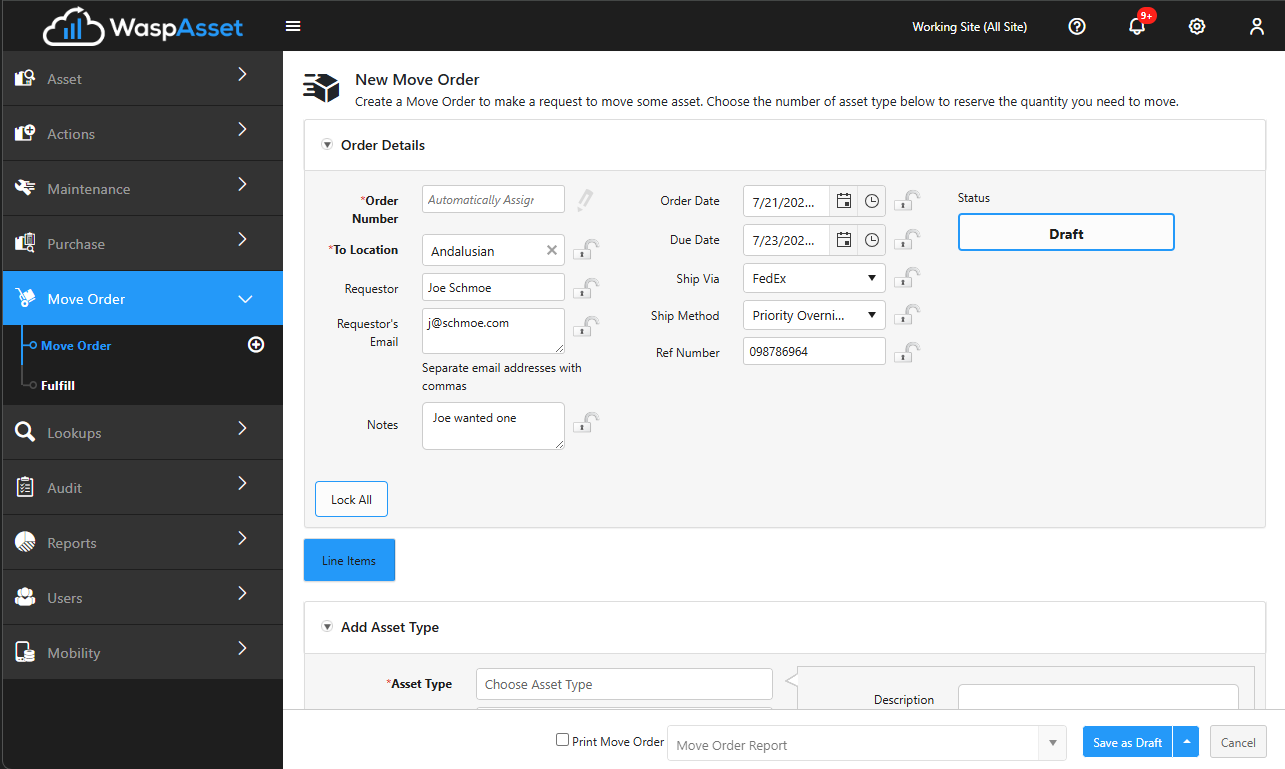
When you create a new move order, you capture:
- A move order number — assigned automatically, or entered yourself. When numbers are automatic, the field shows Automatically Assigned; use the edit (pencil) control to type your own if your number series allows it.
- The destination Location the assets should move to.
- The Requestor and their email, so they can be kept informed. You can enter several email addresses separated by commas.
- Order Date and Due Date for the move.
- Optional Ship Via / Ship Method and a reference number.
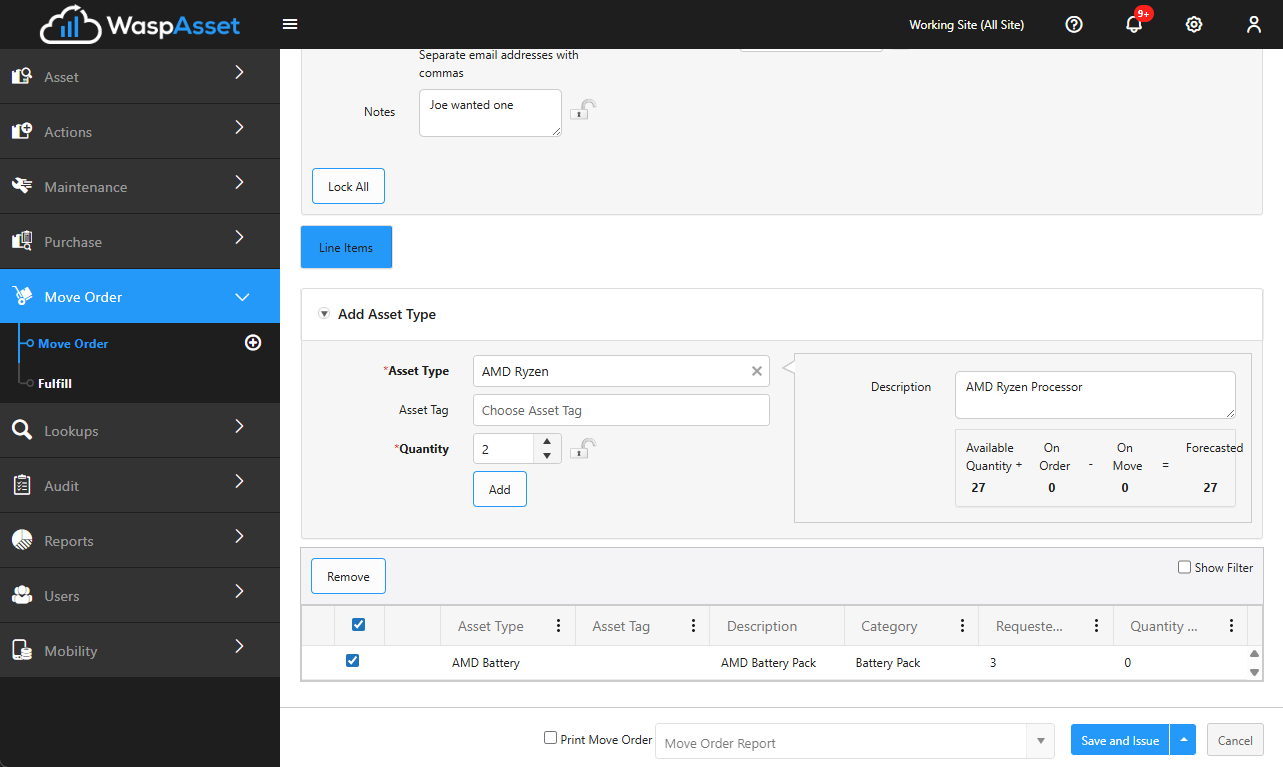
- Notes and the assets (line items) to be moved.
- A status showing where the request stands.
The Move Orders list
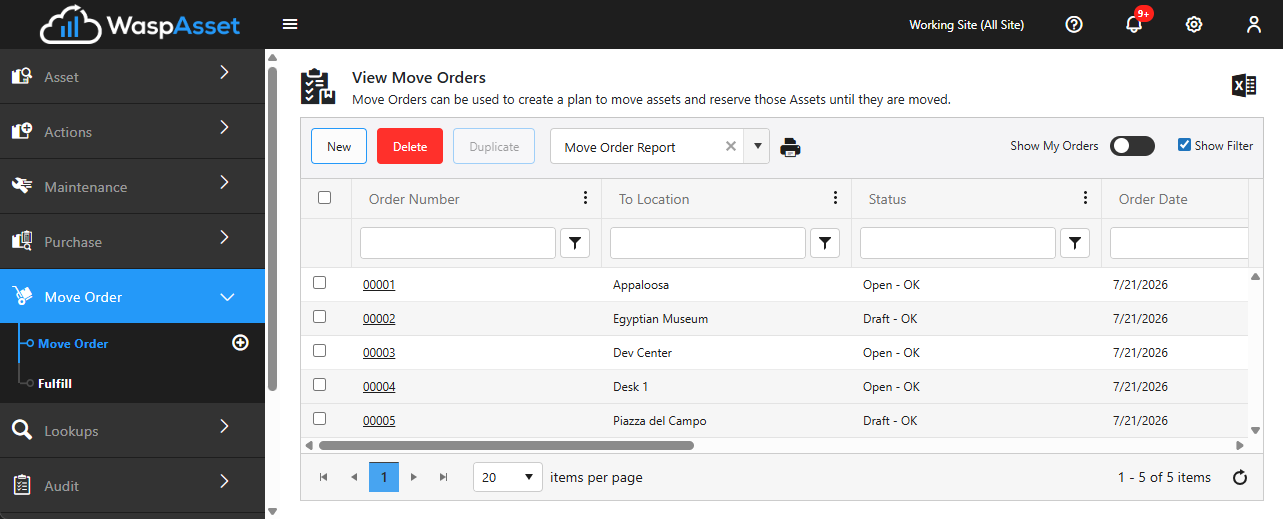
Section titled “The Move Orders list”Open the Move Order section to see the Move Orders list. From here you can:
- New — start a new move order.
- Duplicate — select a single existing move order and copy it into a new one. The details and line items carry over; the notes are cleared and the order date resets to today.
- Delete — select one or more move orders and remove them, with a confirmation prompt first.
- Right-click a move order for a context menu with a Fulfill shortcut, so you can jump straight into fulfilling it without opening it first.
- Toggle My Orders to show only the move orders you created.
- Choose a report and print a move order, or export the list to Excel.
Move orders that have passed their due date are flagged as Overdue.
The lifecycle: create to fulfill
Section titled “The lifecycle: create to fulfill”- Create the move order — record the destination, requestor, dates, and the assets to move. A new order starts as Draft.
- Saving and issuing it moves it to Open, where it’s ready to be worked on. You can also Cancel an order you no longer need.
- Fulfill the move order — confirm the assets and destination and complete the physical move. You can fulfill it in several goes: moving part of the order changes its status to In Progress.
- When every requested asset has been moved, the order becomes Complete on its own and stays open until you close it. You can also close an order yourself with Save & Close: it becomes Closed - Complete if everything had moved, or Closed - Short if some of it never did.
Move order statuses
Section titled “Move order statuses”Every move order has exactly one of these statuses:
| Status | What it means |
|---|---|
| Draft | Created but not yet issued. Nobody has been asked to move anything yet. |
| Open | Issued and ready to fulfill. Nothing has been moved yet. |
| In Progress | Partly fulfilled: some of the requested assets or units have been moved, the rest haven’t. |
| Complete | Everything requested has been moved. Wasp Asset sets this automatically, and the order stays open until you close it with Save & Close. |
| Closed - Complete | Closed with Save & Close after everything had moved. |
| Closed - Short | Closed with Save & Close before everything had moved. The rest will not be moved on this order. |
| Cancelled | No longer needed. |
An open move order is one that has been issued and not yet closed — Open, In Progress or Complete. A partly or fully moved order is still open until someone closes it. A Draft order isn’t open, because it hasn’t been issued. Closed - Complete, Closed - Short and Cancelled orders are finished.
Partly fulfilled multi-quantity assets
Section titled “Partly fulfilled multi-quantity assets”A line for a multi-quantity asset asks for a number of units, and they don’t all have to move at once. Each line keeps the quantity requested and the quantity moved so far — for example 8 of 20 — so an order with any line part-way through stays In Progress until every unit has moved or the order is closed. Units left unmoved when an order is closed short stay where they were.
Troubleshooting
Section titled “Troubleshooting”- A move order shows as Overdue. Its due date has passed and it hasn’t been fully fulfilled — open it to finish the move or adjust the due date.
- I can’t find the destination location. Locations come from your configured sites and locations. If it’s missing, add it first under Sites and locations.
- The move order number field is locked. Numbering is automatic on your account. Leave it to be assigned, or use the edit (pencil) control to override it if permitted.
- The due date won’t save. The due date can’t be earlier than the order date. Adjust one so the due date falls on or after it.
- The Fulfill option is greyed out for a move order. A Draft order needs to be issued (saved and sent) before it can be fulfilled, and Closed or Cancelled orders can’t be fulfilled this way.
Related
Section titled “Related”- Fulfilling a move order — carry out and close a requested move
- Move — relocate an asset on the spot without a move order
- Sites and locations — where destinations come from